
The year your house was built is the best first clue. Homes built before about 1960 were usually plumbed with galvanized steel water lines. From the 1960s on, copper became the standard. Homes built from about 1978 to the mid-1990s may have gray plastic polybutylene. Newer homes and many repipes use PEX. Older homes also tend to have cast iron drains inside and clay sewer pipe out to the street. Then confirm it by looking, because many houses have been partly replumbed.
The quick guide by build year
| When the house was built | Water supply pipe to expect | What to look for |
|---|---|---|
| Before about 1960 | Galvanized steel | Dull gray metal, threaded joints, a magnet sticks |
| 1960s and 1970s | Copper | Orange-brown metal, soldered joints, no magnet |
| About 1978 to the mid-1990s | Copper or polybutylene | Gray plastic stamped “PB2110,” crimp rings |
| 2009 on, and repipes | PEX or copper | Flexible plastic, often red and blue, “PEX” printed on it |
These are national patterns, so treat them as a starting point. A 1955 house may have been repiped in copper decades ago. A 1985 house may have copper, polybutylene, or both.
Galvanized steel: common before the 1960s
Galvanized iron pipe was commonplace in American homes from the late 1800s until around 1960. After that, copper took over.

The trouble with galvanized pipe is inside it. Once the zinc coating wears through, the steel rusts, and rust and mineral deposits narrow the pipe. Water pressure drops year by year, and water can come out brown. In drinking water service, galvanized steel pipe has a service life of about 30 to 50 years. Any original galvanized pipe in Orange County is now past that.
The magnet test. The EPA gives a simple check. Find a pipe where it comes out of the wall, under a sink or at the water heater. Gently scratch it with a coin or key, then hold a magnet to it. If the pipe is silver or gray, hard to scratch, and the magnet sticks, you may have galvanized steel.
This is where Orange County’s oldest tract neighborhoods come in. Garden Grove grew from 5,762 people in 1950 to 121,155 in 1970. Census estimates compiled by the Southern California Association of Governments put 37.3% of its homes in the 1950s, more than any other decade. In West Anaheim, mid-century tract houses predominate, many of them ranch homes from the 1950s and 1960s. Homes of that age that haven’t been repiped are the most likely to still have galvanized lines.
Copper: the standard since the 1960s
Copper replaced galvanized steel as the go-to water pipe in the 1960s. It is the pipe in most Orange County homes built from then on, and in many older homes that were repiped.
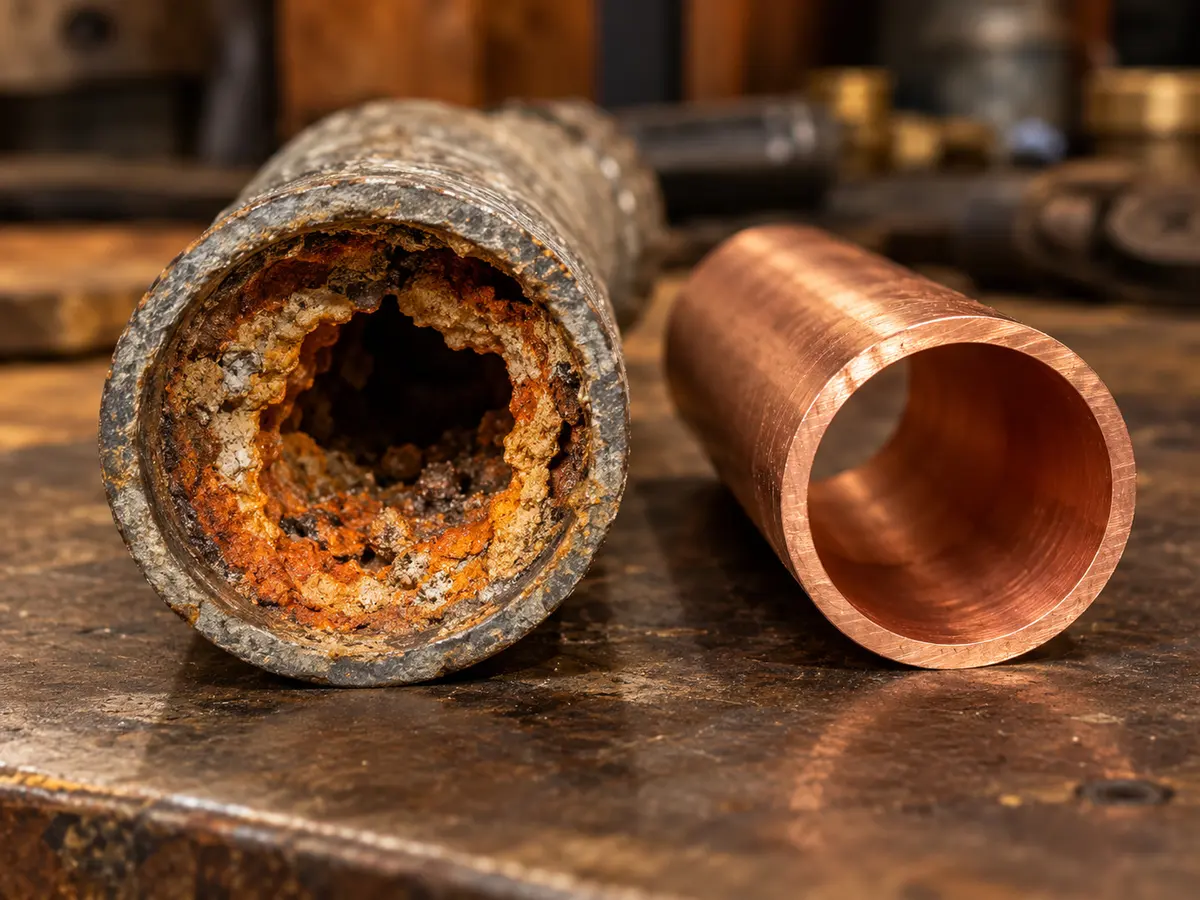
How to tell. Scratch it and it shows the color of a new penny. Older copper may have a green or dark brown film. A magnet won’t stick to it.
Copper lasts a long time, but it isn’t forever. Thin-walled copper can develop pinhole leaks, and hard water doesn’t help. In homes from the 1960s and 1970s, the original copper is now 45 to 60 years old or more.
Irvine shows the timeline well. University Park, the city’s first village, was built in phases starting in 1965, and the first phases of Turtle Rock and Westpark were finished by 1970. Homes there that still run on original pipe are past the fifty-year mark.
Polybutylene: about 1978 to the mid-1990s
Polybutylene is a plastic supply pipe that went into several million US homes from around 1978 into the mid-1990s; some sources run it to 1997. It led to a class action, Cox v. Shell Oil, settled for $1 billion.
The problem is chemical. Chlorine and chloramine in treated tap water appear to break the material down from the inside, most often at fittings, sharp bends and kinks. Because the damage is inside the pipe, it’s hard to judge, and it can fail as a slow leak or a sudden burst without warning.
How to tell. Look near the water heater, under sinks and behind toilets. Polybutylene is classically light to medium gray, though it was also made in other colors. Look for the print “PB2110” along the pipe. The fittings are often joined with plain copper-colored crimp rings. Missing print doesn’t clear it; faded or wall-facing print is common.
Irvine’s Woodbridge village was begun in 1975 and built in phases through the 1980s, which puts many of its homes inside the polybutylene years. Homes from that window anywhere in the county are worth checking.
PEX: newer homes and repipes
PEX, or cross-linked polyethylene, is flexible plastic tubing that has replaced copper in much new plumbing. In California, it was allowed for home water systems case by case from 2007, and approved for general use in 2009.
How to tell. It’s flexible and often color-coded, red for hot and blue for cold, with long bends and few joints. The material and its standards are printed along the pipe, so look for “PEX.”
Drains: cast iron and clay
Supply pipes aren’t the whole story. In older homes, drain lines inside the house are often cast iron, which rusts and builds up inside over decades. The sewer line out to the street may be vitrified clay. Clay lasts a long time, but it is brittle, and it comes in short sections with many joints. Cracks and leaks at those joints are the usual trouble. Newer homes generally use plastic drain pipe.
Questions people ask
Can I find out what pipe I have without opening walls?
Usually. Check where pipes are exposed: at the water heater, under sinks, behind toilets, and where the main line enters the house. Use the magnet and scratch test on metal pipe, and look for printing on plastic.
Is polybutylene a reason to repipe?
Often, yes. Because it fails from the inside and without much warning, replacing it throughout the house is the long-term fix.
My house has more than one kind of pipe. Is that a problem?
Not by itself, but it’s a sign of past repairs. Where different metals meet without the right fitting, the joint can corrode faster.
How Taysom Plumbing can help
If you’re not sure what’s behind your walls, Taysom Plumbing can look. We check the pipe you can see, tell you plainly what you have, and explain whether a repair will hold or a full or partial repipe makes more sense. You get the options with a price for each, and nothing starts until you agree. We respect your home and clean up after ourselves. We’re licensed in California and we answer the phone 24/7. Request a visit online or call (949) 919-7103.

Sources (12)
- en.wikipedia.org/wiki/Plumbing
- en.wikipedia.org/wiki/Polybutylene
- en.wikipedia.org/wiki/Cross-linked_polyethylene
- en.wikipedia.org/wiki/Vitrified_clay_pipe
- epa.gov/system/files/documents/2024-04/customer-guide-for-identifying-service-lines.docx
- polybutylene.ca/identify
- scag.ca.gov/sites/default/files/old/file-attachments/garden-grove-he-0421.pdf
- en.wikipedia.org/wiki/Garden_Grove,_California
- en.wikipedia.org/wiki/Anaheim,_California
- en.wikipedia.org/wiki/Irvine,_California
- en.wikipedia.org/wiki/University_Park,_Irvine,_California
- en.wikipedia.org/wiki/Woodbridge,_Irvine,_California
Want us to take a look?
We answer the phone 24/7. Tell us what’s going on and we’ll give you a price before we start.