
Sewer lines back up after rain for two reasons. Rainwater seeps into a sewer system built to carry wastewater, so the pipes run fuller than usual. And the private line from your house to the street is often already narrowed by roots, grease or cracks. In Orange County most of the year’s rain falls from December through March, so the weeks before are the time to check.
When the rain comes
Orange County’s rain arrives in a short season. NOAA’s 1991 to 2020 averages for Santa Ana show 12.54 inches a year. About 9.9 inches of that, roughly four-fifths, falls from December through March. June through September brings less than a quarter of an inch in total.
That pattern matters for your sewer line. A pipe can sit nearly dry for months, then carry far more water in a few days of storms.
The Orange County Sanitation District, known as OC San, treats wastewater for about 2.6 million people in central and northwest Orange County. On an average day it takes in about 185 million gallons. OC San says heavy rain can more than triple that, as rainwater seeps into the sewer system. During storms it asks people to hold off on laundry and dishwashing until the rain has passed.
Why rain finds the weak spots
The pipe from your house to the sewer main in the street is called the lateral. In many places it belongs to the homeowner, not the city.
The Midway City Sanitary District, which serves Westminster, explains how laterals go wrong. Many older homes still have their original laterals, which over time crack, separate at the joints or fill with roots. Groundwater and stormwater seep in through those cracks. Roof drains or yard drains tied into the sewer, which isn’t allowed, add even more water.
The City of Fullerton puts it simply: tree roots commonly get in through cracks or loose joints. Once inside, roots catch grease, paper and wipes. The line narrows until a storm’s extra flow is more than it can carry.
Older tracts, older laterals
The age of your house is a good first clue to what’s under the yard. Clay sewer pipe was laid in sections joined end to end. Each joint is a place for roots to find. Cast iron, used under many houses, can corrode and scale up from the inside. Our guide to what pipes your house has goes through the eras.
Some examples from around the county:
- Fullerton has houses from the 1920s, where the sewer line may still be clay.
- Garden Grove built more of its homes in the 1950s than in any other decade. Lines from that era may be cast iron or clay that’s now around seventy years old.
- Westminster says most of its neighborhoods went up in the 1960s, so many laterals there are past sixty.
If your house is from those decades and the lateral has never been replaced, it’s worth having it looked at before the season starts. The Midway City Sanitary District suggests inspecting a lateral when a property changes hands and then every five to ten years.
Signs the main line is struggling
One slow drain is usually a clog in that fixture’s own pipe. These signs point further down, to the main line:
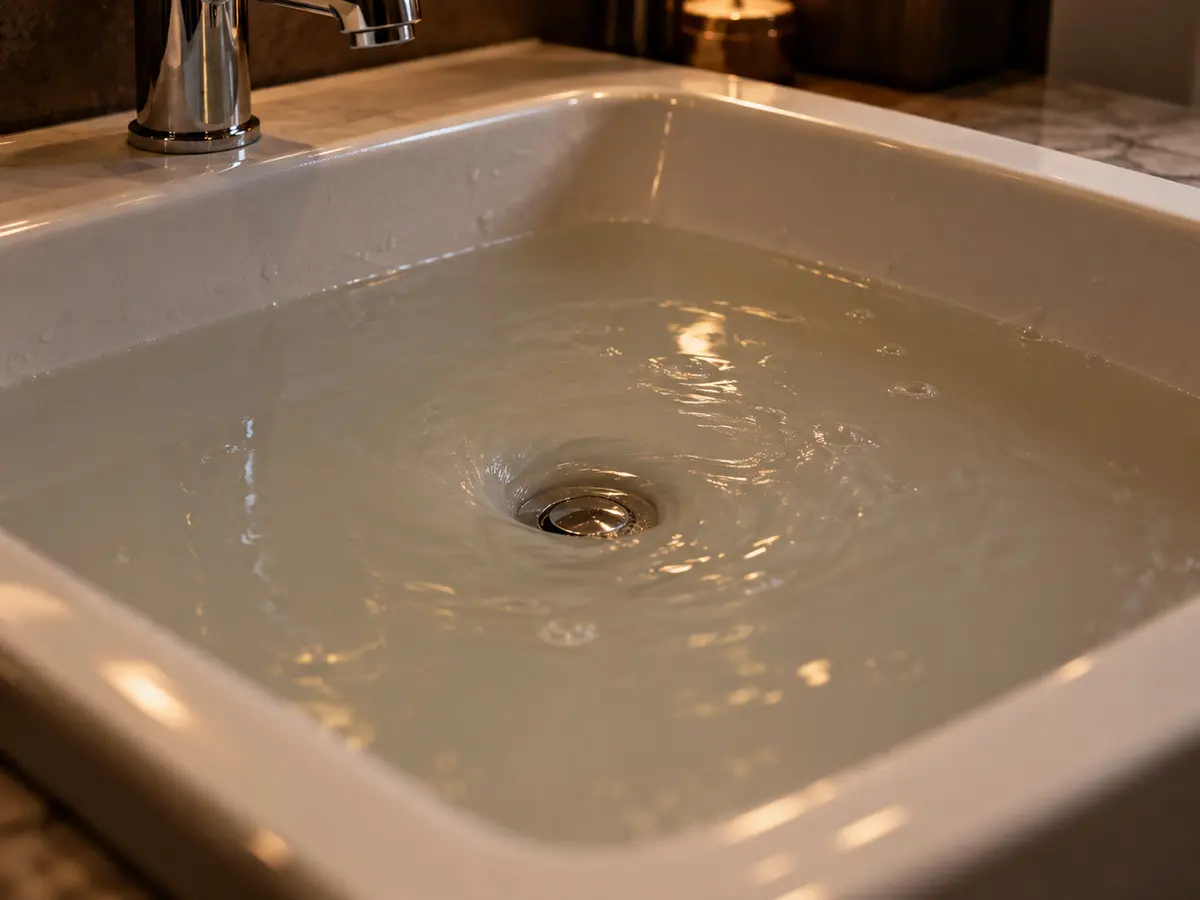
- Several drains slow at the same time, especially on the lowest floor.
- Gurgling from a tub or toilet when another fixture drains.
- Water rising in the tub or shower when you flush or when the washer empties.
- The lowest fixture backing up first. That’s often a ground-floor shower or a floor drain. Water with nowhere to go comes up at the lowest opening.
- A sewer smell in the house or yard that cleaning doesn’t fix.
If water is coming back up, stop running water in the house. Every flush or load of laundry has nowhere to go but up.
Find your cleanout before you need it
A cleanout is a capped pipe that gives access to your sewer line. It lets the line be cleared and inspected without pulling a toilet. The Midway City Sanitary District describes the usual layout: the upper lateral runs from the house to a cleanout near the sidewalk or the property line.
Look for a short capped pipe sticking out of the ground near the foundation, or out toward the sidewalk. Keep it clear of mulch, plants and pavers so it can be opened quickly.
Some older houses don’t have one. Fullerton recommends installing a cleanout and a backflow preventer on the lateral. Its own lateral program asks for a four-inch cleanout at the front of the house.
What not to flush or pour
OC San’s rule for toilets is the three P’s: pee, poop and toilet paper. Everything else belongs in the trash. Its list of clog culprits includes:
- Wipes, including ones labeled flushable
- Sanitary products, diapers, paper towels and facial tissues
- Dental floss and hair
- Medications
- Kitty litter, even the kind that says it’s flushable
Fats, oils and grease are the other big one. OC San says never to pour them down the sink or the garbage disposal. Scrape and wipe pans with a paper towel before washing. Pour grease into a can, let it cool and put it in the trash.
Questions people ask
Who is responsible for the sewer line from my house?
Usually the homeowner. Fullerton says the owner is responsible for the entire length of the lateral. Westminster’s sanitary district says the same of house connections. Check with your city or district.
Why does my shower fill with water when the washer drains?
The washer pushes a lot of water out fast. If the main line is partly blocked, that water backs up into the lowest drain, often the shower. It’s a main-line problem, not a shower problem.
Will a drain cleaner fix a root problem?
No. Store-bought cleaners may shift a soft clog in one drain, but they don’t remove roots from a lateral. Some are hard on older pipes, too.
How Taysom Plumbing can help
Taysom Plumbing handles drain cleaning and repairs across Orange County, and we’re licensed in California. When drains back up, we work out whether it’s one fixture or the main line, clear it, and tell you what caused it. If the line itself needs work, you get the options with a price for each, and nothing starts until you agree. We respect your home and clean up after ourselves. We answer the phone 24/7. Request a visit online or call (949) 919-7103.
Sources (7)
- en.wikipedia.org/wiki/Santa_Ana,_California
- ocsan.gov/news/rainy-day-reminder-conserve-water-during-the-storm
- ocsan.gov/regional-sewer-service
- ocsan.gov/what2flush
- ocsan.gov/fog
- midwaycitysanitaryca.gov/sewer-service-laterals
- cityoffullerton.com/government/departments/public-works/sewer-system/homeowner-responsibility-slmp
Want us to take a look?
We answer the phone 24/7. Tell us what’s going on and we’ll give you a price before we start.