Most of Orange County has very hard water. We have figures for 37 cities and communities, each from the local supplier’s own water quality report. Of those, 34 come in above 10.5 grains per gallon, where the standard scale calls water “very hard.” The softest is Costa Mesa at 6.6 grains per gallon. The hardest is Tustin at 22.
What “grains per gallon” means
Hardness is mostly dissolved calcium and magnesium. Water reports measure it as if it were all calcium carbonate.
A grain per gallon is one grain of calcium carbonate in one US gallon of water. One grain per gallon equals about 17.1 milligrams per liter, which is the same as parts per million. Many reports print hardness in mg/L or ppm, so divide by 17.1 to get grains. Tustin’s 2025 figure is 377 ppm, which works out to 22 grains per gallon.
The University of Nebraska’s extension service publishes the scale used by the U.S. Department of the Interior and the Water Quality Association:
| Grains per gallon | mg/L (ppm) | Classification |
|---|---|---|
| Under 1 | Under 17.1 | Soft |
| 1 to 3.5 | 17.1 to 60 | Slightly hard |
| 3.5 to 7 | 60 to 120 | Moderately hard |
| 7 to 10.5 | 120 to 180 | Hard |
| 10.5 and over | 180 and over | Very hard |
Orange County hardness, city by city
These are average total hardness figures from each supplier’s annual water quality report, hardest first. The year is the year the data covers. Where several places share one supplier, they share a row.
| City or community | Grains per gallon | Supplier | Data year |
|---|---|---|---|
| Tustin | 22 | City of Tustin Water Services | 2025 |
| Yorba Linda | 20.1 | Yorba Linda Water District | 2025 |
| Villa Park | 20 | Serrano Water District | 2025 |
| Anaheim | 18.5 | Anaheim Public Utilities | 2025 |
| Garden Grove | 17.7 | City of Garden Grove | 2025 |
| Orange | 17.5 | City of Orange | 2025 |
| Laguna Woods | 15.5 | El Toro Water District* | 2025 |
| Trabuco Canyon | 15.5 | Trabuco Canyon Water District* | 2025 |
| Coto de Caza, Ladera Ranch, Mission Viejo, Rancho Mission Viejo, Rancho Santa Margarita | 15 | Santa Margarita Water District | 2025 |
| Westminster | 14.7 | City of Westminster | 2025 |
| Fullerton | 14.4 | City of Fullerton | 2025 |
| La Habra | 14.3 | City of La Habra* | 2025 |
| Santa Ana | 14 | City of Santa Ana | 2025 |
| Cypress, Los Alamitos, Rossmoor, Stanton | 13.9 | Golden State Water, West Orange County System | 2025 |
| Laguna Beach | 13.8 | Laguna Beach County Water District | 2025 |
| San Clemente | 13.8 | City of San Clemente | 2025 |
| Newport Beach | 13.6 | City of Newport Beach | 2025 |
| Brea | 13.5 | City of Brea* | 2025 |
| Aliso Viejo, Laguna Hills, Laguna Niguel | 13.3 | Moulton Niguel Water District | 2023 |
| Fountain Valley | 12.7 | City of Fountain Valley | 2025 |
| Irvine, Lake Forest | 12.5 | Irvine Ranch Water District | 2025 |
| San Juan Capistrano | 12.3 | Santa Margarita Water District (ID9) | 2025 |
| Buena Park | 11.9 | City of Buena Park | 2024 |
| Placentia | 11 | Golden State Water, Placentia-Yorba Linda System | 2025 |
| Huntington Beach | 9.5 | City of Huntington Beach | 2025 |
| La Palma | 8.6 | City of La Palma | 2025 |
| Costa Mesa | 6.6 | Mesa Water District | 2025 |
* An average of the supplier’s water sources. Moulton Niguel’s latest available report covers 2023, and Buena Park’s covers 2024.
Everything from Placentia up is very hard. Huntington Beach and La Palma are hard. Costa Mesa is moderately hard.
Dana Point, Seal Beach, Midway City and North Tustin aren’t listed. Their report couldn’t be reached, gave no single figure for the water reaching homes, or the area is split between suppliers. If you live there, check your own supplier’s report.
Why the number changes from city to city
Orange County’s tap water comes from more than one place. The Orange County Water District manages the groundwater basin under north and central Orange County. There, 19 cities and retail water agencies can pump about 85% of their water from the basin. The rest is imported from the Colorado River and Northern California.
South county is different. The water district says about 600,000 people in southern Orange County get most of their water from imported sources.
Every supplier mixes these sources in its own proportions, which is a big part of why neighboring cities read differently. Most reports also print a range next to the average, because hardness isn’t the same at every sample point. Your tap may sit a little above or below the figure here.
What hard water does in your home
Hardness isn’t a safety issue. The World Health Organization has said there doesn’t appear to be convincing evidence that water hardness causes adverse health effects in people. The trouble is what the minerals leave behind.
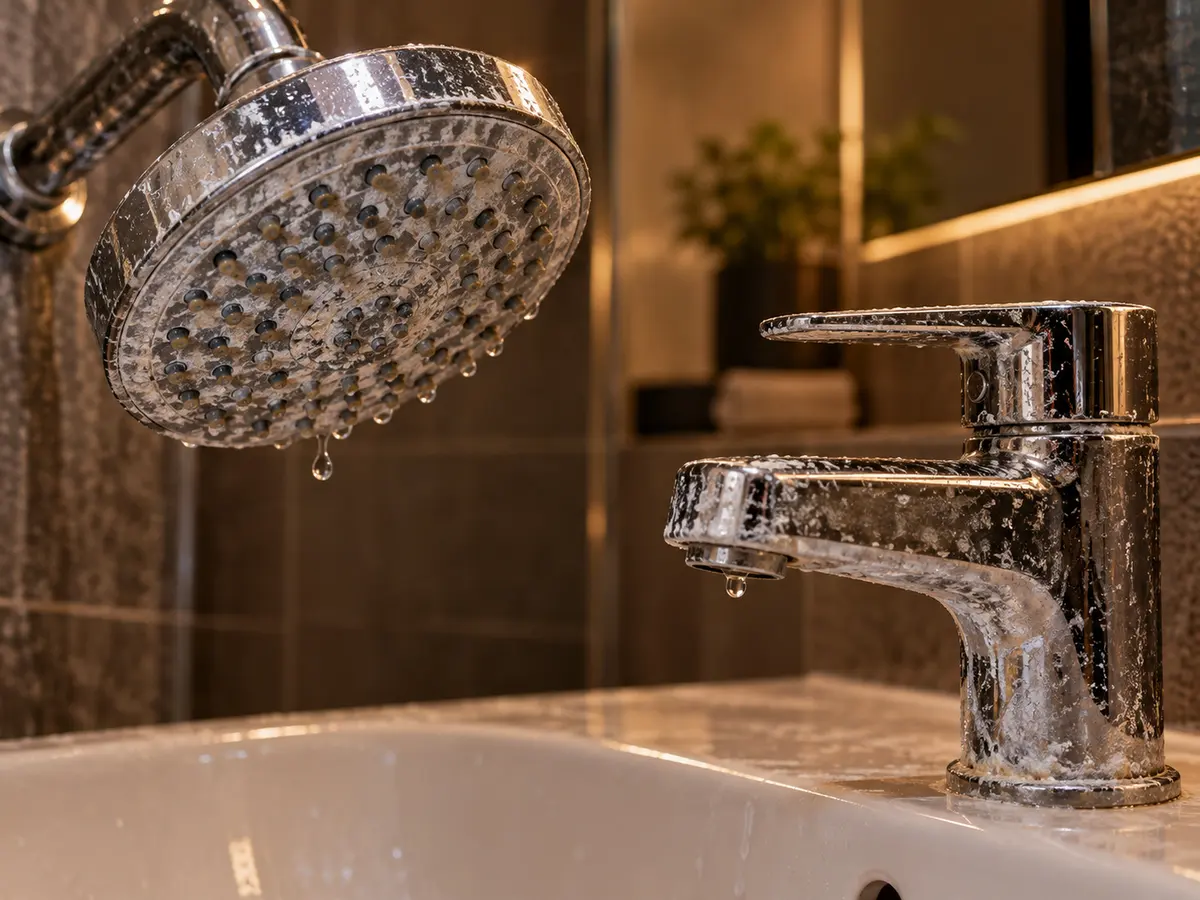
- Scale in the water heater. Heated hard water forms a scale of calcium and magnesium minerals. In a tank, it settles on the bottom, and a tank that rumbles or pops is often heating through a crust of it. In a tankless heater, scale coats the narrow passages of the heat exchanger and cuts the flow.
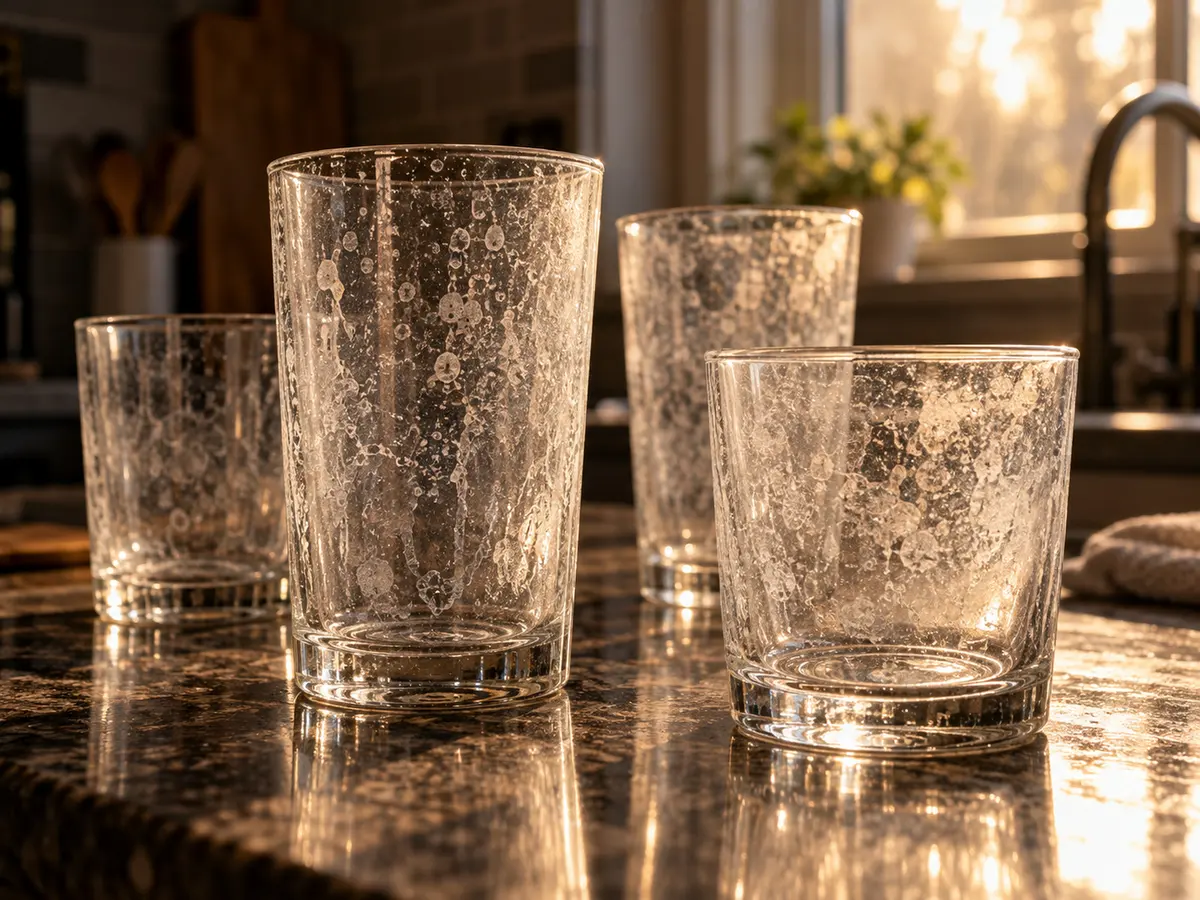
- Crust, spots and film. The same minerals leave white crust on faucets and showerheads, and a cloudy film on glasses and shower glass.
- Soap that won’t lather. Hardness reacts with soap and forms a sticky curd, so it takes more soap and detergent to do the same job.
- Appliances working harder. Nebraska’s extension guide notes that scale can contribute to the inefficient operation or failure of water-using appliances, and can clog pipes over time.
What you can do about it
Start with your own report. Every community water system has to send customers an annual water quality report, called a Consumer Confidence Report, by July 1. Look for the row labeled “Hardness, total.”
Then match the fix to the problem. A water softener removes the calcium and magnesium that cause scale, spots and poor lather. A whole-home carbon filter is a different job: it takes out the chlorine taste and smell and sediment, but it doesn’t soften. A salt-free conditioner changes how the minerals behave so they’re less likely to stick as scale, without a brine tank.
Whatever you choose, flush the water heater on a schedule. In water this hard, tanks and tankless units both collect scale.
Questions people ask
Is Orange County water hard everywhere?
Nearly. In the latest reports, every city on our list except Costa Mesa measures hard or very hard, and most are very hard.
Do I need a softener at 12 grains per gallon?
That’s your call. Twelve grains is very hard on the scale above. If you’re seeing crusty taps, spotty glass and a noisy water heater, a softener is worth talking through.
Will a water filter fix hard water?
Not on its own. A standard carbon filter improves taste and smell. Removing hardness takes a softener, or a conditioner if you only want to cut scale.
How Taysom Plumbing can help
Taysom Plumbing fits whole-home water softeners and filters across Orange County, sized to your water and your household. We look at your water and how your home uses it, explain what we found, and give you the options with a price for each. Nothing starts until you agree, and we clean up before we leave. We’re licensed in California and we answer the phone 24/7. Request a visit online or call (949) 919-7103.
Sources (8)
- extensionpubs.unl.edu/publication/g1274/2016/html/view
- en.wikipedia.org/wiki/Grain_per_gallon
- en.wikipedia.org/wiki/Hard_water
- ocwd.com/learning-center/how-water-works-in-oc
- epa.gov/ccr/ccr-information-consumers
- tustinca.org/DocumentCenter/View/20391
- mesawater.org/sites/default/files/2026-06/final2026consumerconfidencereport.pdf
- lapalmaca.gov/DocumentCenter/View/14110/Water-Quality-Report-2026
Want us to take a look?
We answer the phone 24/7. Tell us what’s going on and we’ll give you a price before we start.